

By Athena Cao
About 40 percent of Rockbridge County elementary school students had been reported as overweight or obese for years. But in 2011, that statistic suddenly dropped to less than 15 percent in all schools. Now, county schools’ Director of School Improvement Cindy Crance said the change was a mistake.
“We always knew that it was off,” Crance said. “But we didn’t have time to look back, and we weren’t sure what was going on with it at that point.”
Rockbridge Report calculations suggest that obesity rates over the last few years have been much higher than the 17 percent national average at the three county elementary schools for which there is sufficient data. Rockbridge Report found that obesity rates in Central, Fairfield, and Mountain View elementary schools range between 20 and 30 percent, with many more students classified as overweight.
Crance reports each school’s obesity rate to the parents every spring. But she stopped including individual students’ weight information about six years ago because parents were offended by what they called the “fat letter.” Crance said now the letters draw little attention.
“Because I am not sending the letter home about their individual child, these percentages over there for most people don’t really mean a whole lot,” she said.
This year’s report on weight levels could go out to parents as early as the end of March. Crance said she expects obesity rates to be higher than in the past because she’s realized the error that caused the numbers to be so low in 2011 and 2012: she was calculating the children’s obesity rate with the method more appropriate for adult obesity rate, Crance said.
Nearly half of Central Elementary School students were overweight or obese in the 2012-2013 year, based on Rockbridge Report calculations of school data. An April 2013 letter sent to parents and signed by Crance lists Central’s overweight and obese rate as only 14 percent.
Similarly, Rockbridge Report numbers from that year are nearly 30 percentage points higher than what was sent out by the school system for Mountain View Elementary and Fairfield Elementary. Overweight and obesity rates for Natural Bridge Elementary could not be calculated because of missing information.

Crance agreed her calculations for the past few years’ obesity rates were incorrect, but did not look at Rockbridge Report’s numbers.
Obesity can lead to Type 2 diabetes, high blood pressure, heart failure and joint diseases. County schools’ Clinical Coordinator Penni Allen said Type 2 diabetes used to be diagnosed mainly among people between 30 and 40 years old, but she said she sees more and more cases of younger children with diabetes.
Obesity is determined using an individual’s body mass index. BMI is calculated by dividing weight by height squared. An adult with a BMI between 25 and 30 is considered overweight; one with a BMI of 30 or more is considered obese.
BMI calculators are available online for the public to use.
While obesity is determined by the flat BMI value in adults, it is measured differently in children, also taking into account age and sex. Centers for Disease Control and Prevention (CDC) publishes BMI-for-age growth charts, which break BMIs into percentiles for boys and girls of different ages.
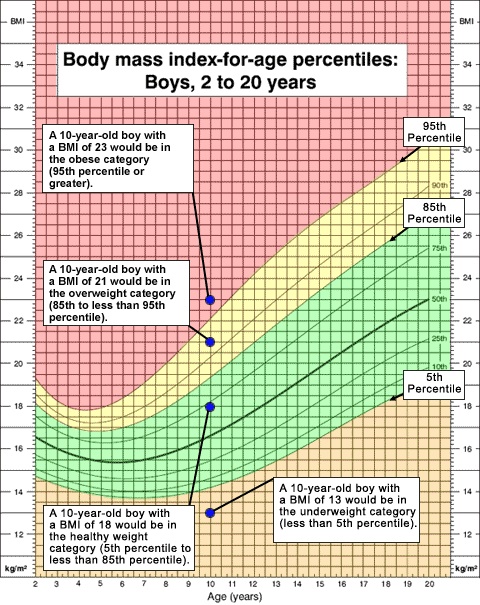
Children and adolescents between 2 and 19 years old are considered to be overweight if their BMI values fall between the 85th and 95th percentile for their age and sex. A child is classified as obese is he or she has a BMI value in the 95th percentile and up.
So a 10-year-old boy with a BMI of 23 would be considered normal weight on the adult scale, but obese on the children’s percentile scale. When the county published its 2011 and 2012 elementary school obesity rates, many children were put into the equation under the wrong weight status.
Although there has been no obvious decrease in the number of obese students in county schools, fewer students are overweight.
Between 2007 and 2010, county elementary schools and middle schools have received a total of $1.5 million from the Carol M. White Physical Education Program, which supports physical education programs for students in kindergarten through 12th grade. Grant Coordinator Gloria Brown, also a PE teacher at Central Elementary, said the grant allowed schools to buy more equipment and hire more PE teachers.
“You can see a difference,” Brown said. “When a child has a piece of equipment to use, they weren’t sitting on the side—everybody was involved and everybody was moving.”
Elementary school students now spend two and a half hours a week in PE classes and recess; middle school students have almost four hours a week of physical activity.
But staying active is not enough to fight obesity. Allen said fast food makes the battle tougher.
“You don’t just get small portions of fast food now—you can super size it,” Allen said. “Plus, it’s easier and cheaper with our economy to buy chicken nuggets rather than fresh fruits and vegetables.”
In 2012, first lady Michelle Obama and Secretary of Agriculture Tom Vilsack announced new rules on government-subsidized school meals. The rules double the amount of fruits and vegetables, require all grains served in school to be whole grains and milk to be low fat, and for the first time set limits on levels of salt and trans fats.
County schools serve chicken nuggets in three-piece servings with 250 calories, 140 of the calories from fat. Rockbridge County High School Nurse Cynthia Maurice said many students order double portions with fries and ketchup. She said it takes a change in mentality to start paying attention to diet.
“It’s what leads to [being] obese,” Maurice said. “There is a traditional southern way of cooking—you can’t have enough butter, you can’t fry it enough.”