

By Lane Smith
In the last two years, the Virginia Department of Education has emphasized more inclusive practices for students in special education programs, a shift that requires increased collaboration among teachers, students and staff.
As a result, more special education students in Rockbridge are taking the same standardized tests as classmates in general education classes. More are also learning in the same classrooms beside them.
“They begin to learn that it’s okay to have people with differences around,” said Ashley Rhodenizer, RCPS director of special education.
Rockbridge County Public Schools had 391 students identified as having a disability, according to the most recent state records. School divisions are required to report the number of students with disabilities receiving special education on Dec. 1 each year.
Nearly all of these students are in some form of general education class, depending on their needs, according to Ashley Rhodenizer, the RCPS director of special education.
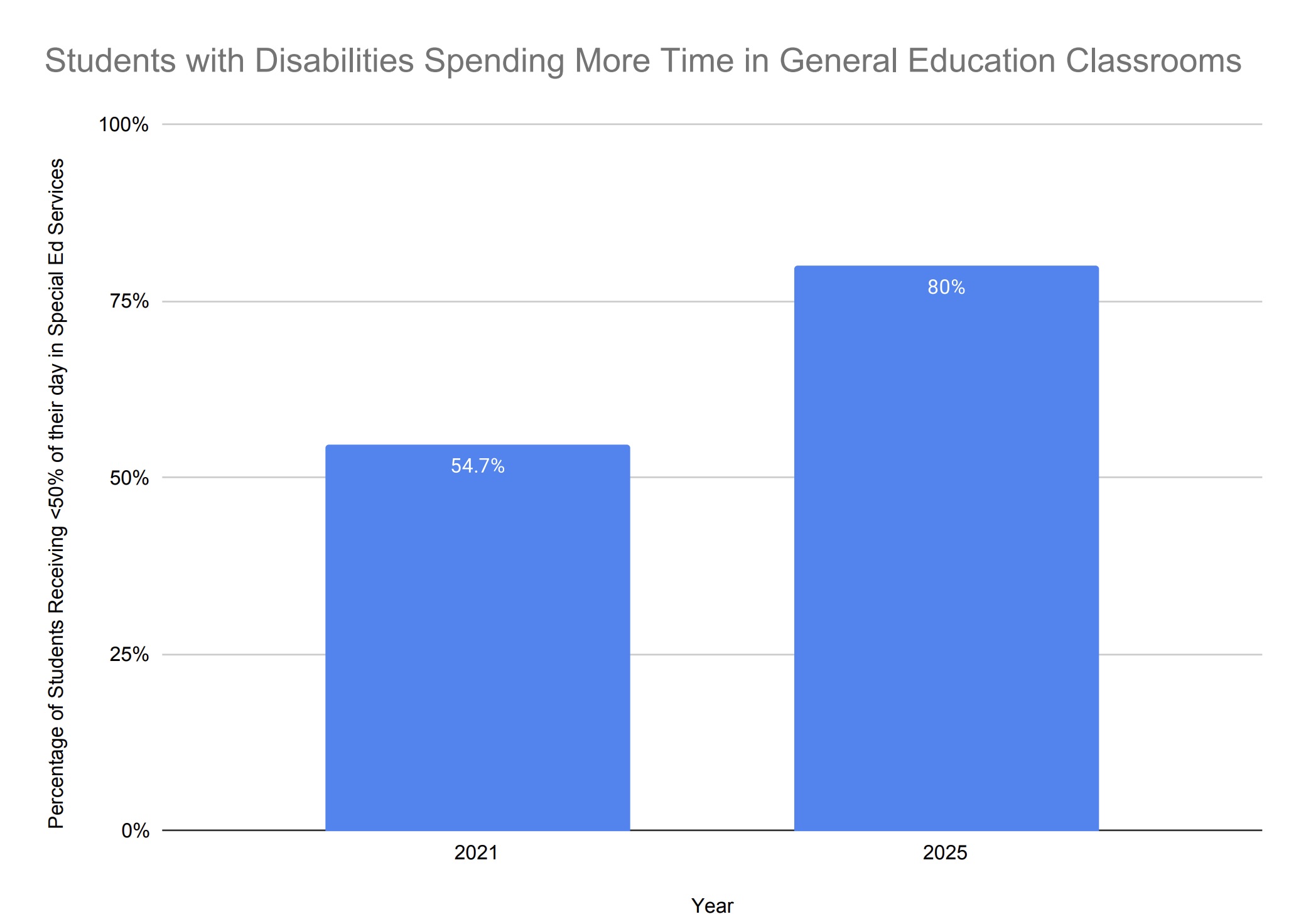
In 2021, 54.7% of district students identified with a disability spent less than half of their day in special education classes. In 2025, 80% of those students spent less than half of their day in special education classes, a shift that shows students are becoming more confident in soft skills and functional communication, according to Rhodenizer.
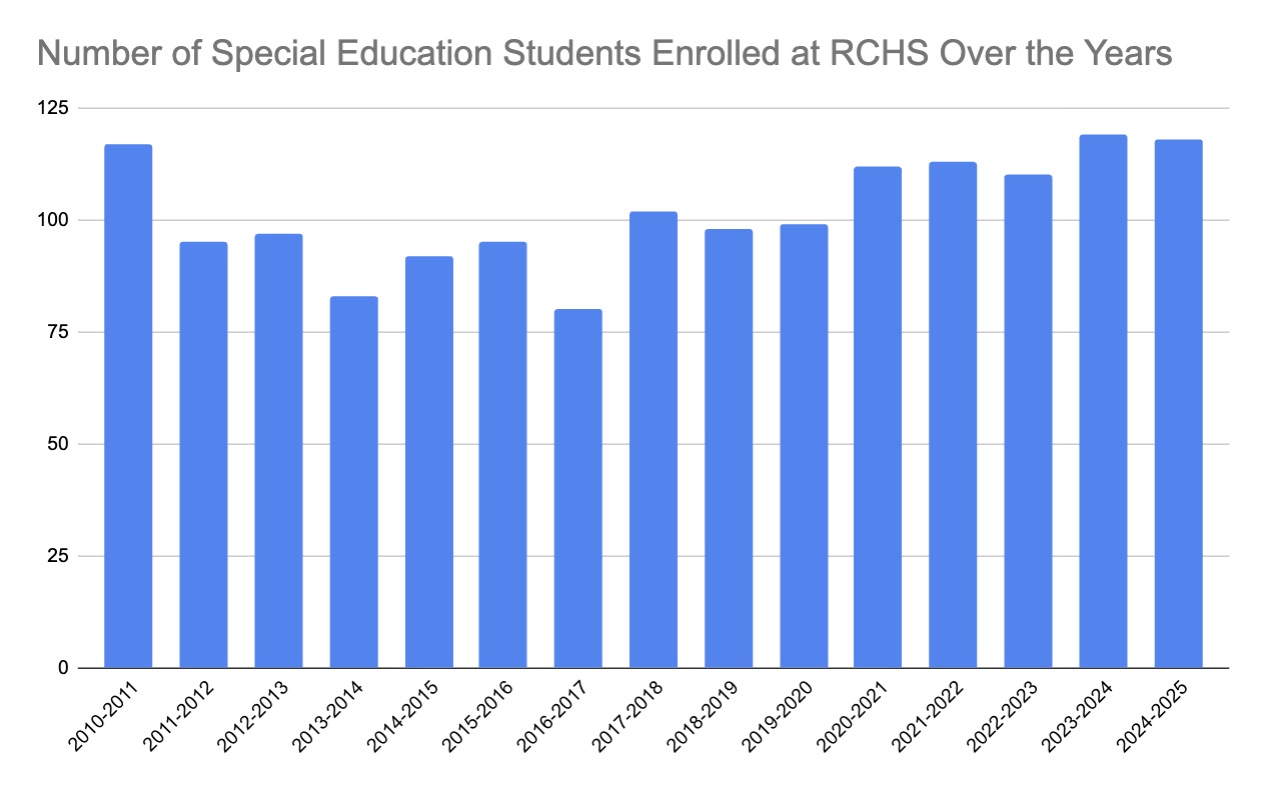
Last school year, Rockbridge County High School had 118 students with disabilities out of 917 total students enrolled, according to the Virginia Department of Education.
Rhodenizer said inclusive practices involve collaboration between special education teachers, general education teachers, instructional assistants and students.
Students can be in a general education classroom with an instructional assistant nearby should they need help with something. Instructional assistants work with teachers to provide support and one-on-one attention for a student while the teacher continues teaching.
Amy Harris, an instructional assistant, works with special education students at the high school. She said she collaborates with general education teachers to modify work.
“Some of them are very supportive of our kids in the classroom,” Harris said. “Some are opposed to it, I think, because they don’t know how to relate to their levels.”
In the last two decades, state policies have evolved.
Jessika Crance, a special education teacher and transition coordinator at the high school, said there were more classes for smaller groups of students in special education.
“At one point there were a lot of what we would consider the self-contained classes,” Crance said. “And I think in recent years now, we have done more trying to make sure that all of our students are included and not excluded into their own individual classes but still meeting their needs.”
Leading up to the 2024-2025 school year, the state changed its policy for special education students regarding Standards of Learning (SOL) and the Virginia Alternate Assessment Program (VAAP). SOL testing is what general education students take and VAAP is for students with significant cognitive disabilities.
Students who are identified with some form of disability have Individualized Education Programs (IEPs), and they work with a teacher who is considered their ‘case manager,’ according to Crance. Case managers do progress reports every four and half weeks for each of their students.
On July 1, 2024, the state began requiring a new guidance tool for IEP teams to determine whether a student qualifies for the alternative testing program. The state’s new policy encourages access to testing for more students if they don’t qualify for the alternative program.
Under the new guidance, some students who had been learning on the alternate track began taking the same tests that general education students, according to Rhodenizer. One student took their first SOL test in eleventh grade.
About 18.6% of the county student population is identified as having a disability, according to Rhodenizer. This number is larger than the national average, which the National Education Association says is about 15%.
Rhodenizer said she believes in an approach that helps students feel included in their learning process.
Instead of labeling students as “you guys who can” and “you guys who can’t,” she said she wants people to ask: “Well, what do you need to get there?”
Rhodenizer said the county’s preschools are all-inclusive and that she sees the benefits of an inclusive environment at that level.
“They begin to learn that it’s okay to have people with differences around,” she said. “And sometimes they’ll give, but kids with disabilities can help and support and give also, so it’s not one-sided.”
By the time these students get to preschool, everyone is used to being together in a classroom rather than having separate, self-contained environments for certain students. Inclusive practices prepare them for a world beyond school, and students benefit from each other.
The high school has eight special education teachers and five to six instructional paraprofessionals, Crance said. The push for inclusive environments comes with emotion for many.
“I think it’s definitely a new mindset sometimes because we can all get stuck in our own little world and want to be protective,” Crance said.
There is a balance between providing opportunity for students to be in the right classroom or take the test that works for them, according to Rhodenizer. The state aims to provide everyone with the chance to take SOL tests and to be in an environment with a variety of peers.
Rhodenizer said people comment about these different practices, but she just wants individuals to have the resources they need to learn.
“Fair is everybody get what everybody needs,” Rhodenizer said. “It’s not everybody gets the same thing.”