

By Erika Kengni
Last October, the Lexington Police Department named Sgt. Jessica Burks as a detective assigned to handle cases of domestic and sexual violence. Six months later, Burks is trying to improve the ways law enforcement officers connect victims to resources.
Burks is working with her counterparts in the Rockbridge County Sheriff’s Office and the Buena Vista Police Department to implement a proven model for handling cases of domestic violence.

The Lethality Assessment Program—Maryland Model (LAP)—was created in 2005 by the Maryland Network Against Domestic Violence and a doctor from John Hopkins University, according to a 2022 study. It has been proven to help prevent domestic homicides.
The Rockbridge County Sheriff’s Office sees about 250 domestic and verbal assaults each year, said Ryan McCullough, an investigator in the sheriff’s office.
Jennifer Smith, an officer of the Buena Vista Police Department, was trained in the LAP when she worked in law enforcement in Norfolk, Virginia. She moved to Buena Vista in 2023 and realized that the department didn’t use the LAP – so, she got to work.
“[It] is a really good tool [for] predicting future domestic related homicides, essentially,” Smith said.
“They went to law enforcement and either didn’t get help or, in the process of getting help, got re-traumatized.”
Smith and Burks worked together to get their departments approved to implement the program. The state tracks departments that use the LAP in order to assess the program’s effectiveness, according to the Virginia Department of Criminal Justice Services.
The LAP involves officers giving victims of domestic or sexual violence a questionnaire when they are first on the scene, Smith said. If the victim is deemed “high-risk” by the questionnaire, then they are immediately connected to local domestic violence resources.
“If we can get them into contact with one of these crisis counselors,” Smith said, “it sometimes helps … to have people advocating for you in your corner, especially at such a low point.”
If a victim is not immediately connected with resources, said Smith, there is a possibility that they go to their abusers.
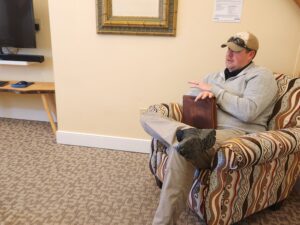
There are many reasons why someone would not want to connect with resources after a domestic incident, McCullough said. They could be afraid of Child Protective Services taking their children or they could be embarrassed.
McCullough originally had some concerns surrounding the implementation of the LAP.
“I had some concerns as far as, if we’ve got someone who’s on the fence of compliance, and they’re not sure if they want somebody to be in trouble,” McCullough said. “[If] we start asking about firearms or strangulations or prior history, we might push them away a little bit.”
However, since learning more about the LAP, McCullough is optimistic that its implementation is going benefit the community.
Law enforcement personnel who are not trained on how to deal with incidents of domestic and sexual violence can risk hurting victims, said Bethny Barrett, the director of education and outreach at SARA, a domestic violence support organization in Roanoke.
“It sometimes helps … to have people advocating for you in your corner, especially at such a low point.”
“You’re going to hear from survivors time and again that they went to law enforcement and either didn’t get help, or in the process of getting help got re-traumatized,” Barrett said. “Or told inaccuracies, or just treated in a way that doesn’t meet the standards that we’d like to see.”
Many law enforcement agencies take domestic violence more seriously because of the activism from survivors of sexual and domestic violence, Barrett said.
The Rockbridge County Sheriff’s Office plans to start training its officers on the LAP within the next month, McCullough said.