

By Matt Kaminer
The number of car crashes in Rockbridge County has jumped this fall, in part because of collisions with deer.
The incidents are reminders that deer mating season, which lasts from October through December, is a hazardous time for drivers.
A recent analysis of car accidents by the Rockbridge County Sheriff’s Department showed a spike in the number of crashes during the mating period. Crashes have increased from 45 in September to 79 in November, with one fatal crash in each month.
According to a press release by the Virginia Department of Transportation, the fall months, which also constitute most of Virginia’s hunting season, can cause deer to become more active and to change locations often, resulting in deer-car collisions.
“Mating season, taking place (from October) through December, is the most likely time for deer collisions to occur,” the press release said. “While you may see a deer at any time of day during this period, they tend to be on the move most at dusk and dawn when they are very difficult to see.”

The risk of hitting a deer is higher in Virginia than in the nation as a whole. Nationwide, one out of 164 drivers will have a claim from hitting a deer, elk or moose in 2016, according to State Farm Insurance. For Virginians, the rate is one out of 97.
Those odds more than double during October, November and December. Nationally the average cost per claim is nearly $4,000.
A representative from Goad’s Body Shop in Rockbridge County estimated that the shop gets “about one or two claims per day” for vehicle accidents involving deer and other wildlife.
The deer habitat in Rockbridge County has been disrupted dramatically over the past year. One of the most popular grazing spots for wildlife in the county had been a large field of grass on the west side of the Washington and Lee University campus. However, that location was used to build W&L’s new Upper-Division Housing Village, ultimately requiring those animals to relocate.
“There is a fairly significant deer population that now lives in that wooded area behind the village, near Nelson Street and throughout Woods Creek between the campuses of W&L and VMI,” said Ethan Kipnes, W&L’s director of public safety.. “W&L also doesn’t allow weapons on campus, so deer that stay in this area don’t run the risk of being hunted.”
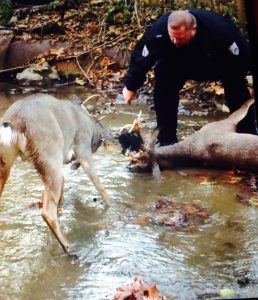
While most wildlife issues are managed by city or county law enforcement, W&L’s public safety officers have also dealt with their fair share of calls. One such incident occurred last year as two antlered deer interlocked their horns in a fight behind the university’s Lenfest Center for the Arts on Nelson Street, resulting in the death of one of the bucks.
“We worked with the police department, which also employs animal control officers, and we were lucky to have an officer on duty who is experienced in dealing with wildlife, so ultimately they were able to unlatch the deer and allow the living animal to continue on its way,” Kipnes said.
VDOT initiated a project in 2015 to reduce the number of deer-car accidents in the state. The measures include late-night messages on digital billboards and fencing on certain state highways.
To avoid or stay safe during deer collisions, VDOT recommends driving the speed limit or reducing speed when deer-warning signs are in sight, using bright headlights when possible and appropriate, and always wearing a seatbelt. If you hit a deer, VDOT advises, be sure to contact local law enforcement. If the animal is dead, you may keep the carcass after reporting the accident once an officer has seen the animal and provided a certificate of possession.
While there have been no reported deer collisions yet this month in Rockbridge County, the sheriff’s department reported a call regarding a dead bear in the road on East Midland Trail on Dec. 1.